 QCSP
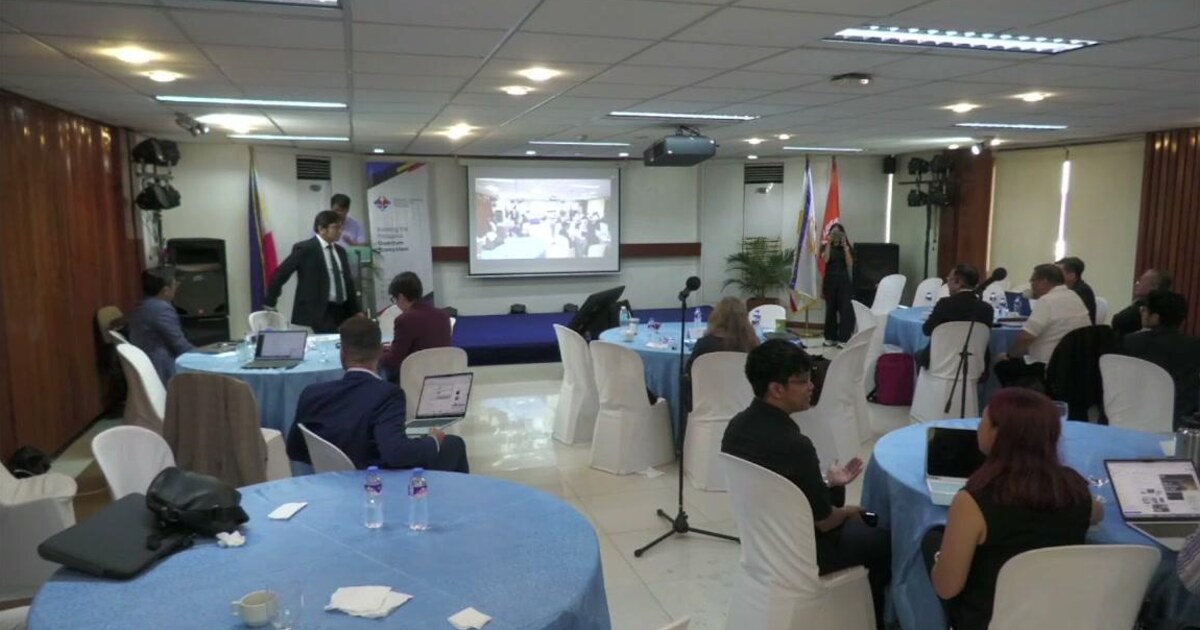
PASIG CITY, Philippines — The Quantum Computing Society of the Philippines (QCSP) convened the Quantum Readiness Workshop: Computing, Workforce, and Quantum-Safe Security on April 23–24, 2026 at the Development Academy of the Philippines (DAP) in Pasig City.
 |
|---|
| Participants at the Quantum Readiness Workshop, held at the Development Academy of the Philippines in Pasig City. |
The two-day forum was co-organized by QCSP, IBM Asia Pacific, the Department of Science and Technology (DOST), and the Development Academy of the Philippines–Graduate School of Public and Development Management (DAP-GSPDM). It brought together national government leaders, regulators, researchers, educators, industry representatives, and international technology experts to move from awareness of quantum technologies to concrete action planning.
The workshop was built around two themes: Day 1 focused on strategy, policy, and ecosystem development, while Day 2 focused on action planning, coordination, and implementation.
Day 1: Strategy, Policy, and Ecosystem Development
The opening program placed the workshop within the Philippines’ broader digital transformation and innovation agenda. Messages from DAP, QCSP, DOST, and the Department of Information and Communications Technology (DICT) emphasized responsible technology adoption, public-sector foresight, and the need to prepare institutions before quantum risks and opportunities become urgent.
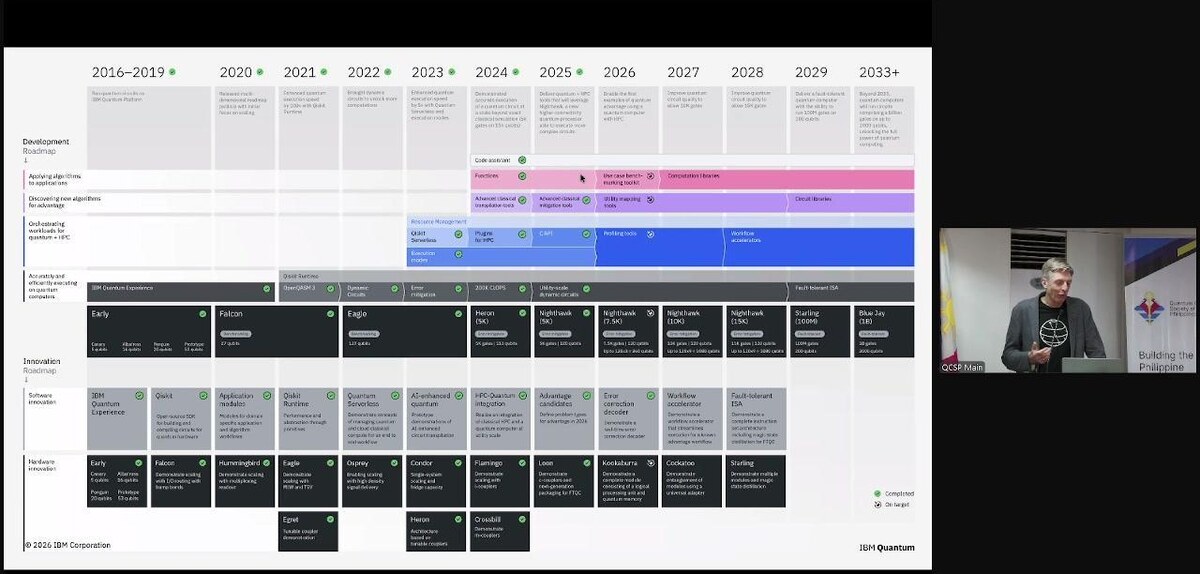
Dr. Jan-Rainer Lahmann then introduced the fundamentals of quantum computing, including qubits, superposition, entanglement, and measurement. He clarified that quantum computers are specialized accelerators rather than replacements for conventional computing, and he used examples in simulation, optimization, chemistry, materials, and machine learning to show where quantum approaches may eventually offer value.
 |
|---|
| The fundamentals session connected quantum concepts with IBM’s hardware and software roadmap. |
The quantum-safe sessions, led by Umut Cikla and Dr. Efstathia Katsigianni, covered the post-quantum cryptography landscape. They explained the “harvest now, decrypt later” threat, the global standardization of quantum-resistant algorithms, and the long lead time institutions need to find their cryptographic dependencies, prioritize systems, and manage migration. The sessions stressed crypto-agility: organizations need inventories, ownership, policies, testing environments, procurement requirements, and monitoring mechanisms so their cryptographic controls can evolve safely.
The afternoon widened the lens from technology to national capability. Sessions examined priority industry and government use cases, IBM’s partnerships and roadmap, the components of a national quantum ecosystem, and workforce pathways. Dr. Eric Galapon presented the State of the National Quantum Science and Technology Roadmap.
A multi-stakeholder plenary on strategic risks and national readiness closed the day. It considered what could happen if the country fails to prepare within five years, with security exposure, delayed standards adoption, limited workforce, fragmented governance, dependence on external suppliers, and lost competitiveness emerging as recurring concerns.
 |
|---|
| The plenary dialogue brought government, industry, research, and international perspectives into one readiness discussion. |
Day 2: From Dialogue to Sector Action
On the second day, participants organized into sector working groups and used a common response template covering gap analysis, access to resources and linkages, ethics and governance, readiness self-assessment, priority use cases, and immediate actions. The groups examined eight lenses: finance, energy, ICT, defense and security, disaster risk reduction and management, logistics and transport, health, and the quantum supply chain.
Across sectors, participants proposed practical applications such as post-quantum migration, portfolio and resource optimization, fraud detection, secure government communications, disaster-response routing, weather and risk analysis, health research, and supply-chain optimization. They consistently reported gaps in awareness, specialized expertise, research infrastructure, sustained funding, standards, procurement readiness, data and system inventories, and coordination. Ethical concerns included cybersecurity risks during the transition, overdependence on vendors or foreign technology, unequal access to capability, misuse, and the consequences of not adopting quantum technologies.
The plenary consolidation produced a shared set of immediate actions: national awareness and executive education, cryptographic inventories and readiness assessments, targeted pilots, curriculum and specialist training, clearer standards and policy guidance, shared research access, and cross-agency working mechanisms.
Day 2 closed with a hands-on Qiskit workshop in the afternoon.
Next Steps
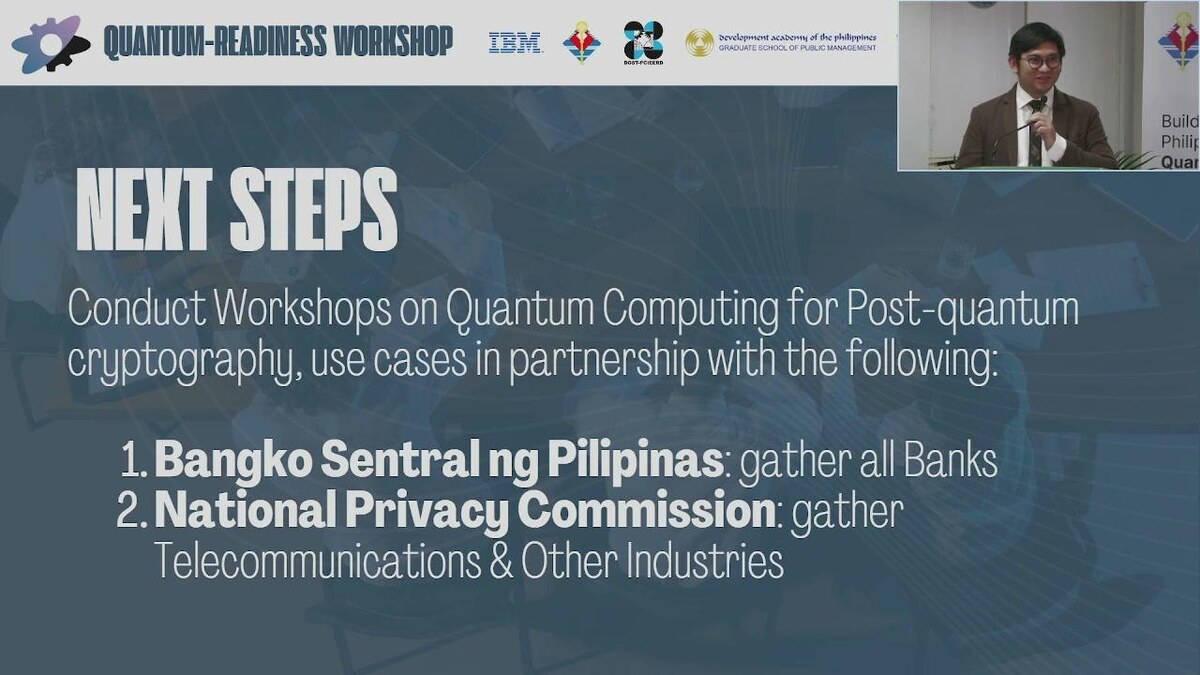
The closing session called for continued workshops, a written technical report or whitepaper, and follow-through with the Bangko Sentral ng Pilipinas (to bring together banks) and the National Privacy Commission (to bring together telecommunications and other industries) on post-quantum cryptography and quantum computing use cases.
 |
|---|
| The closing session identified follow-on workshops with the Bangko Sentral ng Pilipinas and the National Privacy Commission. |
In August 2026, QCSP went on to conduct a quantum readiness workshop for the Bangko Sentral ng Pilipinas.
Key Takeaways
- Readiness is broader than technology. It depends on leadership, policy, workforce, procurement, research access, data governance, supplier management, and institutional coordination.
- Quantum-safe migration begins with discovery. Organizations cannot plan a migration without knowing where cryptography is used, which systems are critical, who owns them, and which vendors are involved.
- Use cases need disciplined selection. Potential value should be weighed against feasibility, data readiness, technical maturity, cost, public value, and workforce requirements.
- Workforce is the mechanism of capability. Foundational literacy, practitioner training, advanced research, faculty development, and access to tools or testbeds reinforce one another.
- Coordination is a strategic asset. Shared standards, clear lead agencies, and public-private-academic collaboration reduce duplication and accelerate learning.
- Responsible adoption requires governance. Ethics, security, inclusion, accountability, and vendor risk must be addressed from the outset.
The workshop’s recommended follow-through includes a national coordination mechanism, a baseline quantum-safe assessment, targeted awareness and executive education, a workforce pipeline, evidence-generating pilots, stronger standards and procurement guidance, and sustained documentation and knowledge exchange.
The strongest signal from the two days was not a call for premature technology acquisition, but for coordinated preparation: better awareness, clearer governance, stronger research and workforce pathways, credible sector use cases, and early quantum-safe planning. QCSP and its partners created a practical bridge between global technical developments and Philippine institutional realities.
More information about the workshop is available on the event website.
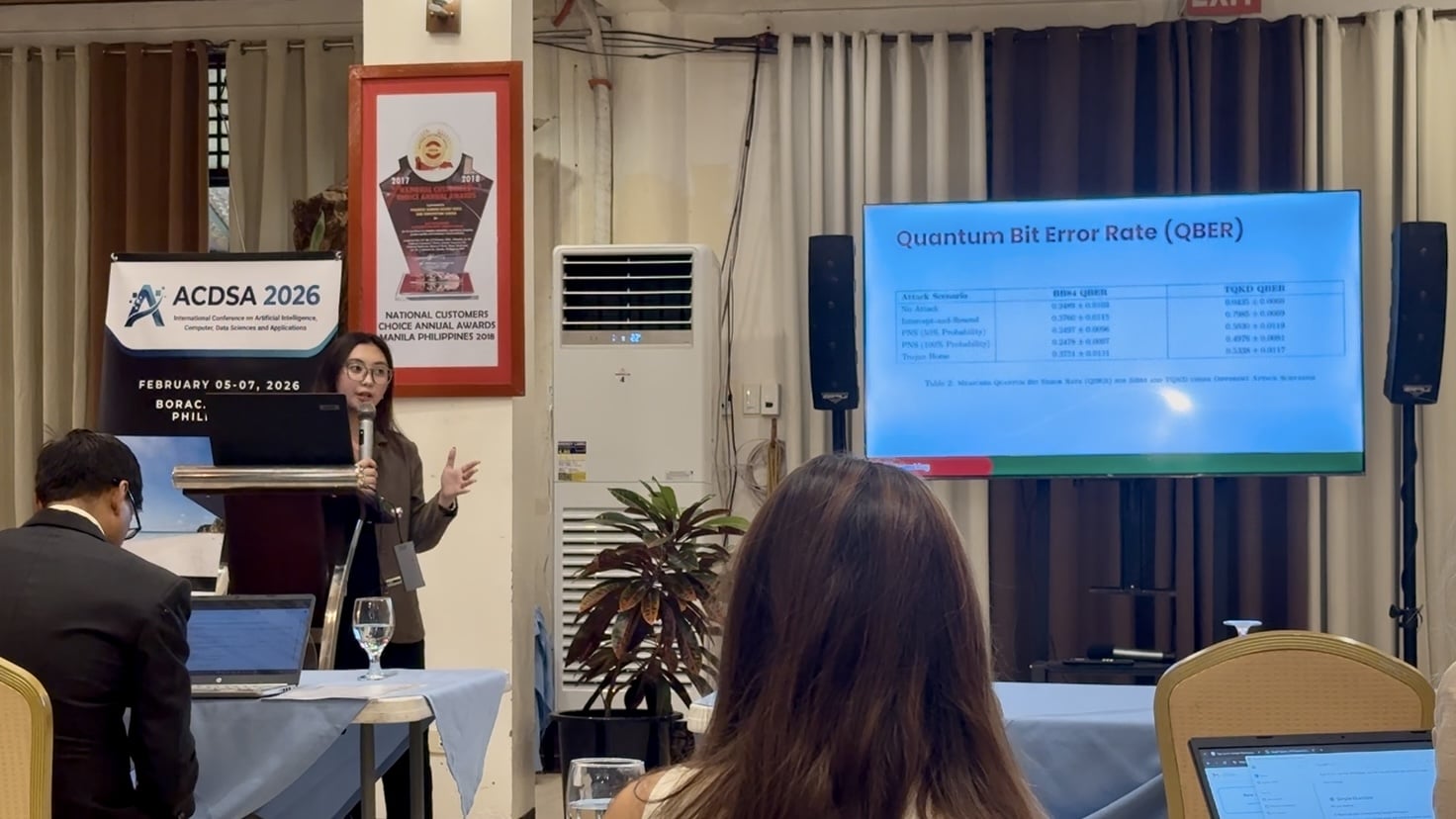 QCSP at ACDSA 2026: Two Papers Accepted and Presented in Boracay
