 QCSP
QCSP 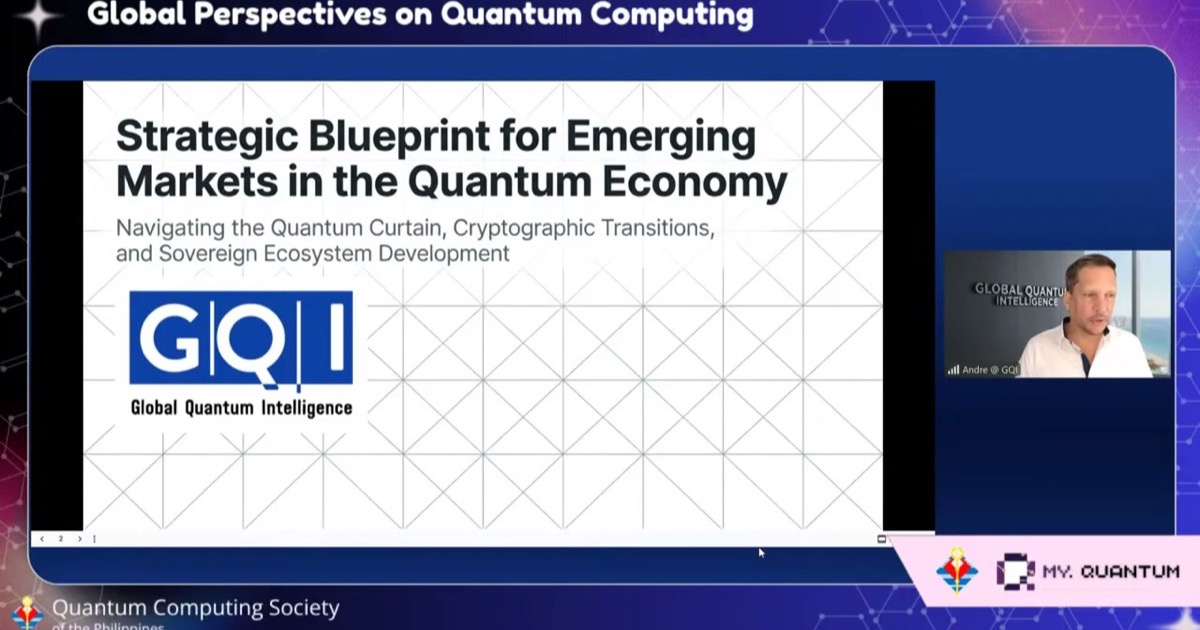
MANILA — August 6, 2026. The Quantum Computing Society of the Philippines (QCSP) and its My Quantum initiative drew an online audience from across the country and beyond on Wednesday evening for a webinar that delivered a blunt message to emerging economies eyeing the quantum computing race: stop chasing use cases, and start building a national vision.
 |
|---|
| Andre M. König presents “Strategic Blueprint for Emerging Markets in the Quantum Economy” during the My Quantum webinar “Quantum for Emerging Markets.” |
The session, titled “Quantum for Emerging Markets,” featured Andre M. König, founder and chairman of the global community OneQuantum and CEO of Global Quantum Intelligence, a market and business intelligence firm that advises governments, investors and Fortune 500 companies on quantum strategy. The talk was moderated by Atty. Giselle Batapa-Sigue, a former DICT undersecretary and longtime advocate for Philippine digital governance, and hosted by QCSP volunteer Trisha May Ariola.
In a recorded welcome message, QCSP president Bobby Corpus Jr. traced the organization’s roots to 2017, when it was known simply as Quantum Computing Philippines, and its 2022 rebranding into OneQuantum Philippines after connecting with König’s global network — a relationship that later brought König to the country’s first dedicated quantum conference, QISTCON.PH, in Cebu in mid-2025.
“This Is Not an Innovation — It’s National Infrastructure”
König opened by framing quantum technology not as an incremental improvement on existing tools, like AI or blockchain, but as a discovery rooted in a century-old branch of physics. “All other technologies are just an innovation… For me, quantum is fundamentally different. It is a national infrastructure,” he said, noting that global government funding for quantum research has already topped $60 billion — figures that exclude China’s undisclosed spending, which he said would dwarf every other bar on the chart.
He pointed to 42 official national quantum missions now active worldwide, spanning capitals from Washington and London to Tokyo and Canberra, and warned that a “quantum curtain” is forming: an exclusive club of nations with access to talent, supply chains and eventually fault-tolerant quantum computers, while others are left “standing outside the building.”
A Ticking Clock on Encryption
Much of the urgency, König explained, stems from recent breakthroughs in quantum error correction and new qubit architectures that have moved up the timeline for when quantum computers could break widely used encryption. Elliptic curve cryptography (ECC) — the protocol underpinning everyday tools like Zoom, blockchain transactions and much of internet traffic — was considered safe from quantum attack until a few months ago. Now, he said, a “reasonable worst-case” break could arrive as early as 2028, with RSA-2048 encryption following by 2029. “Somebody that is not a fan of Andre might be able to use their quantum computer and hack this Zoom,” he joked, before adding more soberly that the accelerated timeline is reshaping how governments in Washington, London, Berlin and Tokyo talk about quantum — “almost a quantum war.”
The “Super Adopter” Strategy
Rather than racing to buy quantum hardware — which König dismissed as producing little more than “press releases” and no real utility — he urged emerging markets to become “super adopters.” The model, borrowed loosely from how Gulf states like Qatar, Saudi Arabia and the UAE built long-range national agendas (Qatar 2040, Saudi Vision 2050), starts by envisioning where a country wants to be decades from now and reverse-engineering the technology, talent and policy needed to get there.
He was especially critical of what he called the “quest for use cases” — pilot projects chasing marginal, unproven advantages that ultimately deliver “absolutely nothing.” Return on investment, he said, is “the worst story you can tell” in quantum right now, since meaningful ROI is unlikely for at least five years. Instead, he recommended low-commitment, short-term partnerships with multiple quantum cloud providers to build institutional familiarity — “like going to the gym” — while investing seriously in talent development starting as early as high school.
König also flagged supply-chain access as an inescapably geopolitical decision. Using his firm’s proprietary “PESTLE”-style framework — scoring political, economic, social, technological, environmental and legal factors across 51 metrics — he advised countries to identify their genuine regional strengths rather than copying larger powers, and to consider banding together, citing ASEAN’s collective market size and young, educated workforce as an underused asset.
Lively Q&A Tackles Finance, ASEAN and Misconceptions
During the open forum, moderator Batapa-Sigue — who chaired ASEAN’s Digital Senior Officials’ Meeting as a former deputy minister — pressed König on how the region could act collectively rather than individually. He acknowledged limited firsthand knowledge of ASEAN but pointed to its demographic and economic scale as a significant, underleveraged advantage.
Asked about quantum’s implications for central bank digital currencies and capital markets, König gently redirected the question, calling it another example of premature “use case” thinking, though he acknowledged financial modeling and risk analysis are among the fields most likely to see quantum advantage — alongside a real cryptographic risk to blockchain-based clearing and settlement systems.
One audience member’s question conflating quantum mechanics with violations of classical thermodynamics gave König a chance to clarify a common misconception: quantum technology doesn’t break Newtonian physics, he said, though phenomena like superposition and entanglement are being explored by startups — including one spun out of Paris’s Institut Pasteur — to build novel “quantum batteries.”
Asked directly where the Philippines should prioritize its limited R&D budget, König pointed to the country’s young, highly educated population as its strongest card, urging investment in making the next generation “quantum native” starting in high school and college — a strategy he compared to Japan’s national push toward what its own quantum mission calls “Society 5.0.”
Looking Ahead
Closing the session, QCSP announced a full slate of upcoming activities: the second Quantum Information Science and Technology Conference (QISTCON.PH 2026), set for November 9–11 in Cebu City, with registration opening August 17; a three-day Quantum Roadshow running August 17–21 across Colegio de San Juan de Letran, Bulacan State University and the University of the Philippines Diliman; and open research positions at the UP Baguio MIND Lab under Dr. Ian Jasper Agulo.
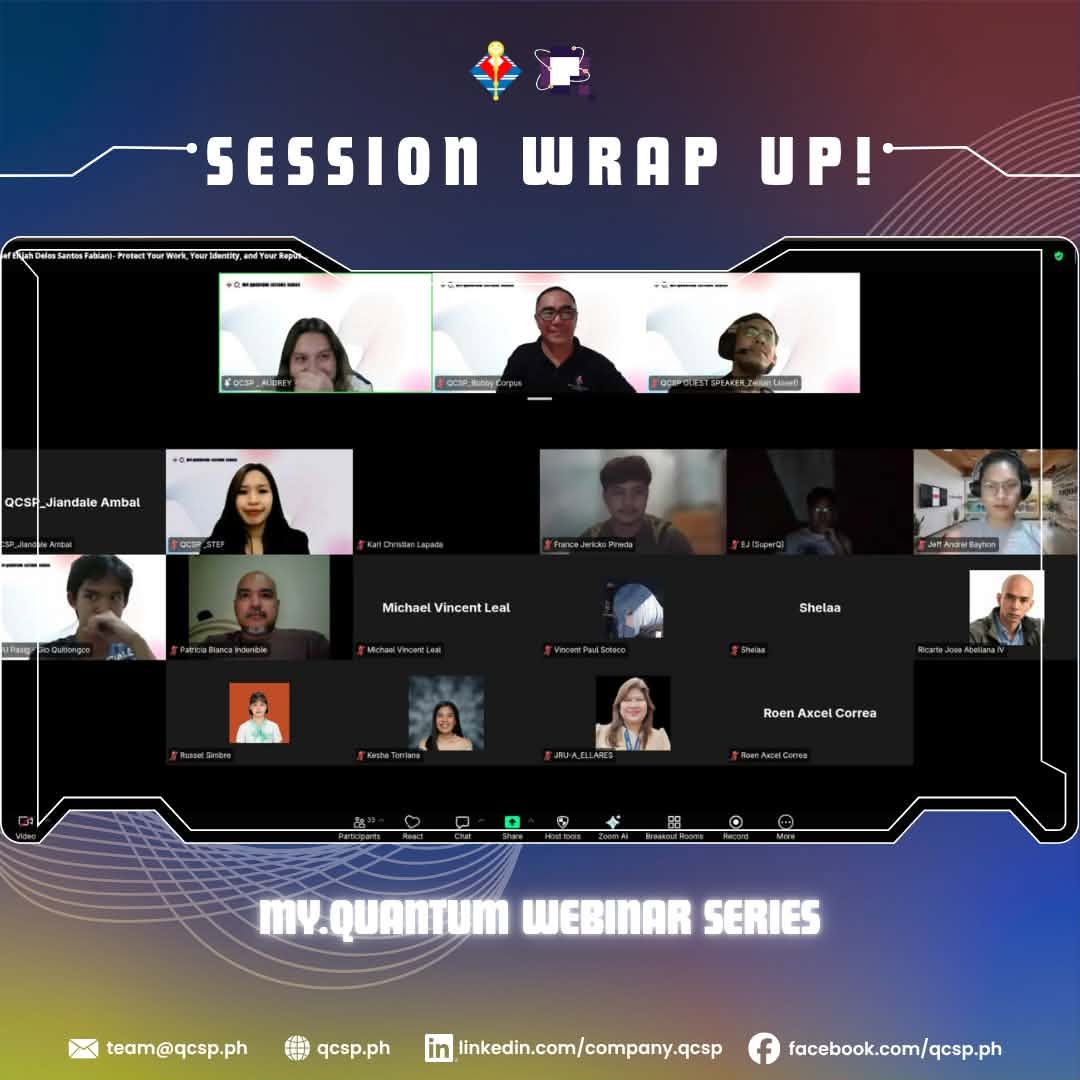
Certificates of appreciation were presented to König and Batapa-Sigue before organizers closed the evening with a virtual group photo, capping what host Ariola called an evening of “eureka moments” for a community trying to position the Philippines ahead of what König repeatedly described as a closing window of opportunity.
 QCSP, MyQuantum Open Webinar Series with Focus on Post-Quantum Digital Trust